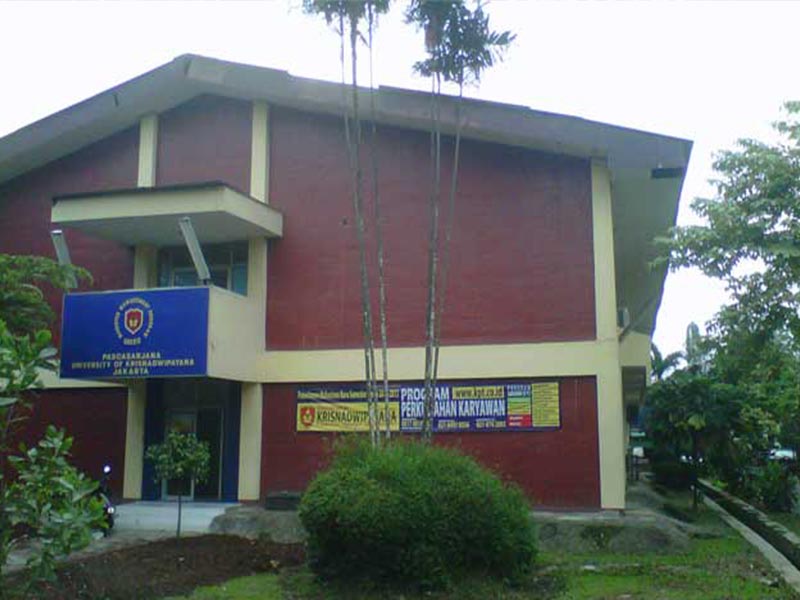
Prospectus and Curriculum Study Program
(Required/Elective Courses, Job/Career Prospects, Profession, and Competencies of Graduates)
| 1. S2 Master of Management Program |
Graduate Degree : M.M. (Master of Management)| Prospectus of Master of Management (MM, S2) |
Management is a process of planning, organizing, directing and monitoring efforts of the members of the organization and use of resources to achieve organizational goals.
Management science developed in line with the era of globalization, information technology and komunikasiyang provide an understanding of approaches or procedures important in researching, analyzing and solving managerial problems.
Master of Management (MM) prepares graduates to be globally minded professional, has integrity, vision, determination, and social responsibility.
Master of Management (MM) prepares graduates entering employment business and non-business-based, nationally and internationally, as professionals in finance, marketing (marketing), HR (human resources), operational as well as entrepreneurs (Entreprenuer).
Competencies of Graduates of Master of Management
Graduates of the Master of Management of STIE IGI Program has a strong ability to control theory and professional skills as well as a comprehensive perspective; develop professional mental attitude oriented problem solving based workflow management-systems thinking; has scenario building capability in solving management problems; able to develop theoretical studies Recent conceptual; has the ability to digest a thought management; ability to perform a variety of basic and applied research that excel in the field of management.
Master of Management of STIE IGI graduates equipped with the knowledge, academic and professional ethics, ability and skills to manage various types of organizations in a comprehensive manner in the areas of finance, marketing, human resources, and operations, as well as strategic decision making.
In addition, it is also equipped with the ability to utilize information and communication technologies in managing the company, developing management information systems, creating a business plan, conduct business negotiations with presentations and good; economic analytical skills, quantitative and management; collate and analyze the financial performance of public enterprises and nonpublic; perform analysis of financial markets (forex market, money market and capital market); draft feasibility study; planning and marketing research; analysis of International Trade, etc.
Basic competency Master of Management of STIE IGI is to have quality and intellectual integrity; highly competitive both academically and morally; able to adjust to the changes; realize that science is always advancing and evolving; able to browse and obtain scientific information; know-how and can continue continuous learning; in dealing with each problem, and is able to reveal the structure of the core problems and set priorities stages of completion; know and can take advantage of the usefulness of information technology can apply science and knowledge, competent and skilled in the field of management; able to solve problems logically, utilize data / information available; able to use these concepts to explain things that are not / less clear; able to work independently and effort; able to actively participate in the working group; able to communicate with experts in other areas of expertise and utilize aid them; able to effectively utilize the resources available; able to start forming units pioneering entrepreneur in the field of management, be able to follow new developments in the field of management, conduct research, or to follow the course of study at the next level.
Master of Management of STIE IGI graduates have the ability to lead a business organization with strong integrity, the ability to communicate both orally and in writing, ability to cooperate in teams, the ability to understand science to ethics, the ability to understand the knowledge in the field of management, the ability to lead others.
Profession and Career Graduates of Master of Management
Graduates of the Master of Management (MM) of STIE IGI can work and career as professional managers and experts in the field of Marketing, Finance, Human Resources, Production and Operations on manufacturing companies, service companies, hospitals, hotels, banking, education, etc.
As an entreprenuer, academics or a career in government and private agencies as professional managers and experts in the fields of marketing, finance, human resource management, production and operations in manufacturing companies, service companies, hospitals, hotels, banking, education, information technology, communication, and so on.
Being a management consultant / business that are reliable, and insightful entrepreneurs information and communication technology.
Master of Management / MM (S-2)
Courses |
* = Concentration / Specificity / Options Courses
SKS = Semester Credit Units| Courses | SKS | | International Accounting * | 3 | | Behavioral Accounting * | 3 | | Strategic Management Accounting * | 3 | | Industry Cost Analysis * | 3 | | Investment Analysis and Risk Management * | 3 | | Financial Statement Analysis * | 3 | | Bussiness Process Re - Engineering * | 3 | | Managerial Economics | 3 | | E-Marketing * | 3 | | Business Ethics and CSR | 3 | | Leadership * | 3 | | Industrial Safety and Health in Business * | 3 | | Advanced Corporate Finance * | 3 | | Multinational Finance * | 3 | | Entrepreneurship and Innovation Management | 3 | | Marketing Communications * | 3 | | Marketing and Hospitality Services * | 3 | | Financial Institutions and Instruments Derivatives * | 3 | | Global Supply Chain Management * | 3 | | Cost Management * | 3 | | Industrial Relations Management * | 3 | | International Management * | 3 | | Investment Management | 3 | | International Financial Management * | 3 | | Advanced Financial Management (Corporate) | 3 | | Performance Management * | 3 | | Quality Management and Productivity | 3 | | Advanced Marketing Management | 3 | | Advanced Operations Management | 3 | | Risk Management * | 3 | | Special Strategic Management | 3 | | Advanced Human Resource Management | 3 |
| | | Courses | SKS | | International Marketing * | 3 | | Marketing Services * | 3 | | Strategic Marketing * | 3 | | Managing Training and Development | 3 | | Research Methods for Business Operations | 3 | | Strategic Operations and Process Management | 3 | | Strategic Value Creation * | 3 | | Organizational Development * | 3 | | Business Valuation * | 3 | | Control Financial Planning * | 3 | | Consumer Behavior * | 3 | | Organizational Behavior and Corporate Culture * | 3 | | Strategic Product Portfolio * | 3 | | Project and Development Management * | 3 | | Financial Engineering * | 3 | | Human Resource Research * | 3 | | Advanced Financial Research | 3 | | Marketing Research * | 3 | | Thesis Seminar (Seminar Thesis) | 1 | | Advanced Accounting Information Systems * | 3 | | Executive Support Systems for Business | 3 | | Management Control Systems * | 3 | | Enterprise Resource Planning Systems * | 3 | | Management Statistics | 3 | | Management Marketing Strategy | 3 | | Human Resource Management Strategy * | 3 | | Consumer Strategy Development * | 3 | | Financial Structure * | 3 | | Organization Theory and Design | 3 | | Thesis | 6 | | Special Topics Marketing * | 3 |
|
|
| 3. S2 Master of Technical Program |
Graduate Degree : M.T.| Prospectus of S2 Master of |
Competencies of Graduates of S2 Master of
Graduate Program in Electrical Program aims to improve the mastery of knowledge and skills of participants in the field of Electrical .Upon completion of training, participants are expected to have academic and professional capabilities that can be utilized independently in developing science and education in the field of electro technology, research and industry.In general, S1 Electrical graduates have professional skills in the field of electrical in public life, to follow and master the concepts of science and the development of new technologies in the field of electrical , as well as be able to apply their knowledge for the benefit of the industry needs is local or global; has the ability to organize, design and make a decision in principle to apply their knowledge to achieve competitive results and optimal, analytical and critical thinking in the decision-making of electrical problems; has the ability to apply science and principles of electrical and has a strong personal integrity, creative, and competent; has the ability formulate and analyze problems of electrical at the same time develop the settlement system; has the ability to design a system in the field of electrical ; able to communicate effectively; has the ability to apply systematic, stages, methods and concepts that are needed in the field of electrical .
Bachelor of Electrical basic competence is to have quality and intellectual integrity; highly competitive both academically and morally; able to adjust to the changes; realize that science is always advancing and evolving; able to browse and obtain scientific information / ; know how and can constantly learning; handling each problem, was able to uncover the structure and core issues and set priorities stages of completion; know and can take advantage of the usefulness of mathematics and information technology can apply science and knowledge; proficient and skilled in electrical ; may solve problems logically, utilize data / information available; able to use these concepts to explain things that are not / less clear; able to work independently and effort; able to actively participate in the working group; able to communicate with experts in other areas of expertise and utilize their help; able to effectively utilize the resources available; able to start forming units stub entrepreneur in the field of electrical , was able to follow new developments in the field of electrical , conduct research, or to follow the course of study at a further level.
In particular, a graduate in Electrical equipped with the knowledge, professional ethics, ability and skills to apply the theories of electrical is growing rapidly by utilizing information and communication technologies in the areas of:
Electric Power Systems , includes energy conversion , transmission and power distribution, interconnection systems, techniques and safety regulation, high voltage , power system analysis, power system security, industrial electrical , design and analysis of network electrical, power quality analysis, electrical machines, transformers, power electronics, electrical measurement, test and calibration of medium voltage electrical devices, etc.
Telecommunications and Multimedia , covering communication systems, transmitting and receiving information, the transmission and propagation of electromagnetic waves, the transmitter and receiver design, the use of microprocessors in signal processing other information and communication systems, communication techniques applied, telecommunications network, modem design package thin traffic radio and TV repeater design, multimedia, database design techniques, design of electronic information network , telecommunications project management, design systems and the provision of communications radar antennas, etc.
Control Systems , includes mathematical models, system dynamics, control components and equipment, with computer settings, planning and analysis of the system model, the optimal setting techniques, digital regulation technique, robotic techniques and the application of other regulatory systems , systems , PLC (Programmable Logic controller), setting the process industry instrumentation, industrial automation, system analysis, system simulation and optimization systems, etc.
Computer Systems , includes hardware and computer software, system logic, the use of logic in computer , the use of computers as a means of data processing and the making of the program and analyzing the results of the program, and interfacing digital, digital processing, multimedia networks, computer networks, systems database, the design of computer systems, programming languages, digital imagery, technology (design) integrated circuits, etc.
Electronic , and includes a series of electronic components, integrated circuits, electronic equipment design, component manufacturing techniques, and the use of measuring tools in the industry and biomedical electronics, design and electronics systems based on fuzzy logic, medical electronics, instrumentation, techniques Scale Integrated circuit large (VLSI), analog electronics system design, digital electronics system design, design of integrated electronic systems, electronic devices, technology (design) integrated circuits, etc.
Profession and Career Graduates of S2 Master of Electrical
Bachelor of Electrical can work and a career in government or private institutions (national and multinational), service industries (such as banking), as well as various electronics companies, electric power, telecommunications, control systems, computer systems, such as telephone, radio, television, instrumentation, radar, computers, control systems, satellite telecommunications systems, informatics, automatic control, robotics, antennas, wireless telecommunications, PLC (Programmable Logic Controller), image processing and machine vision, digital signal processing, renewable energy, energy audits, power generation and transmission and distribution, and digital interfacing, digital processing, multimedia networks, computer networks, database systems, computer systems, integrated circuits, electronic components, electronic equipment, electronic measuring instruments in industry and biomedical, medical electronics, analog electronics systems and digital, etc.
Being Entreprenuer with established consulting services of electronics, electricity consultant, telecom consultant, control systems consultant, computer systems consultant, or contractor or production company founded electronics, telecommunications, control systems, computer systems, etc.
S2 Master of Engineering
Courses |
* = Concentration / Specificity / Options Courses
SKS = Semester Credit Units
| Courses | SKS | | Stochastic processes | 2 | | Mathematical Techniques | 2 | | Numerical analysis | 2 | | Advanced Power Electronics | 3 | | Advanced Synchronous Machines | 3 | | Sist. Electromechanical | 3 | | Mechanical Settings | 3 | | Advanced Power System Analysis | 3 | | Power converter | 2 | | Stochastic processes | 3 | | Peng system. linear | 3 | | Measurement systems | 2 | | optimization System | 2 | | Numerical techniques | 2 |
| | | Courses | SKS | | Discrete Control System | 3 | | Peng system. Optimal | 3 | | Hardware Settings | 3 | | Processing & Adj. SINY | 3 | | Architects Computer and Data Acquisition | 3 | | Random processes | 3 | | Information theory | 3 | | Traffic Engineering | 3 | | Advanced electromagnetics | 3 | | Sist. Kom. Digital | 3 | | Encoding technique | 3 | | Tech. Net. Telkom | 3 | | Digital Signal Processing | 3 | | Advanced Digital Communications Systems | 3 |
|
|
| Courses | SKS | | SEMESTER I | | Technology Management and Industrial and Environmental Innovation | 3 | | Green Technology and the Industrial Age | 3 | | Technology and Information Systems Industry and the environment | 3 | | Development and Environment Management | 3 | | | 12 | | SEMESTER II | | Industrial Economy | 3 | | OHS Management System | 2 | | Information Technology Management and Governance | 3 | | Research Methods | 3 | | | 11 | | SEMESTER III | | Business Feasibility Study | 3 | | Supply Chain Management | 3 | | Quantity and Reliability Analysis | 3 | | Thesis Preparation Seminar | 2 | | | 11 | | SEMESTER IV | | Human Resources Policy Analysis | 2 | | Thesis | 6 | | | 8 |
| | | Courses | SKS | | Specialization in Environmental Technology | | Environmental Management System | 3 | | Supporting Capacity and Environmental Capacity Analysis | 3 | | Environmental Law and Public Policy | 3 | | Thesis Preparation Seminar | 2 | | | 11 | | Specialization in Information Technology | | Business Intelligence | 3 | | Cyber ??Forensics | 3 | | Business and Information Technology Harmony Management | 3 | | Thesis Preparation Seminar | 2 | | | 11 |
|
|
| 3. Study program Master of Administrative Sciences / MA (S-2) |
Graduate Degree : M.A. or MA.| Prospectus of Master of Administrative Sciences (MA) |
Globalization is happening on the social, political, and economic development makes the problems faced by central and local governments increasingly complex. Therefore, the problems and challenges of building a multidimensional problems between the one related to the other. To resolve these problems required the presence of resource officers who have high professional ability, the ability to integrate various disciplines approach effectively.
Purpose of Education
Master of Administrative Science (MA) is designed with a theoretical and practical cargo operations to meet the needs of academics and practitioners needs bureaucracy with the aim of:
- Having knowledge and extensive knowledge of public administration, able to understand complex issues, able to anticipate and respond to the problems of public administration that is always evolving, and is able to apply a set of theoretical-conceptual analysis and practical operations to solve development problems.
- Able to analyze, plan, formulate, implement, manage, and evaluate public policies appropriately and rationally.
- Being able to conduct research and development in the field of public policy, individually or in the form of cooperation.
- Ability to interact academically and professionally to change the dynamics of the environment is growing very rapidly in the social, political, economic and public administration.
Competency Master of Administration
| Elements of Competency Decree No. 132 / U.2000 Article 7 Paragraph (3) | Main Competencies | Supporting Competence | Other Competence |
| (1) | (2) | (3) | (4) |
| Substance Studies Master of Public Administration | Generate Master of Public Administration graduate who has the ability to think creatively and critically and be able to solve problems that arise in the field of public policy, manajamen public services, local administration , financial administration area, and regional planning. | Having the ability to search for the best alternative to generate an accurate analysis before taking decisions in the various aspects that arise in the practice of public administration. | capabilities graduates to understand the concept, able to adapt to environmental and governmental, private and public. |
| Personality Development (MPK) | The understanding and practice of the basic philosophy and constitutional responsibility of the state as a form of society and the state | Living and understand fully the teachings of any religion as spiritual beliefs individuals to harmonize the implementation of state administration science, both in the field of public policy, manajamen public services, local administration, financial administration area, and regional planning with the beliefs held | Understanding and mandalami concepts and general terms and typically used in the field of public policy, manajamen public services, local administration, financial administration area, and regional planning. |
| Mastery of Science and Skills (MKK) | Understanding the basic principles of the science of public policy, manajamen public services, local administration, financial administration area, and regional planning and able to perform concept -The concept is basically in solving problems encountered in environment governmental organizations and community | Always follow and master the development of new concepts and new technologies in the field of public policy, manajamen public services, local administration, financial administration area, and implementation of regional development planning in order to useful scientific and efficient. | Able to communicate the science of public policy, manajamen public services, local administration, financial administration area, and regional planning appropriately and efficiently to the development of public administration and community through approaches suited to the goals are achieved. |
| Expertise Work (MKB) | Able to assess the performance achieved in empowering expertise in the field of public policy, manajamen public services, local administration, financial administration area, and regional planning to address issues and challenges facing the development of the state administration and technology | Having the ability in planning and decision-making in carrying out their duties in a professional manner to achieve optimal results. | Able to develop professional performance dengnan use analysis sharp and coherence in solving problems that arise in the course of the administration of the country. |
| Work Behavior (MPB) | Able to systematically apply the stages, methods and concepts in the field of public policy, manajamen public services, local administration, financial administration area, and regional development planning necessary for the purpose of overcoming the problems encountered | Shaping attitude is always proactive in dealing with problems and thinking analytically to take decisions primarily related to public policy, manajamen public services, local administration, administrative local finance, and regional planning. | Train skills in coordination and cooperation with other professions in order to obtain optimal results. This is done by providing job assignments in groups. |
| Bohemian society (MBB) | Ability to adapt science encountered in the field of public policy, manajamen public services, local administration, financial administration area, and regional development planning. against the practices of public administration, and public | Master in restructuring and depth in the field of public policy, manajamen public services, local administration, financial administration area, and regional development planning with human behavior and attitudes that run it. | Mastering the concept of decision-making in the field of science that has been mastered by considering factors and behavioral habits executive and decision-making within the state administration system. |
Master of Administrative Sciences
Courses |
* = Concentration / Specificity / Options Courses
SKS = Semester Credit Units
| Courses | SKS | | Public Accounting and Audit Management * | 3 | | Analysis of Regional Financial System * | 3 | | Public Policy Analysis * | 3 | | Organizational Culture * | 3 | | Political Economy * | 3 | | Ethics and Accountability | 3 | | Bureaucratic Ethics and Good Governance * | 3 | | Evaluation of Public Policy * | 3 | | Philosophy of Administration | 3 | | Formulation and Implementation of Public Policy * | 3 | | Policy & Regional Financial Management * | 3 | | Governance and Partnership * | 3 | | Public Communication * | 3 | | Man. Regional Development Project * | 3 | | Strategic Management of Public Sector * | 3 |
| | | Courses | SKS | | Performance Management & Measurement * | 3 | | Financial Management & Budget Local Gov. * | 3 | | Public Service Management * | 3 | | Management Performance Measurement * | 3 | | Project Management * | 3 | | Apparatus Resource Management * | 3 | | Research Methodology | 3 | | Local Government * | 3 | | Development Planning * | 3 | | Social Change and Cultural Organization | 3 | | Public Administration Reform * | 3 | | Theory of Decentralization * | 3 | | Theory of Public Administration * | 3 | | Thesis | 8 |
|
|
| 4. Study program Master of Law / MH (S-2) |
Graduate Degree : M.H. or MH| Prospectus of Master of Law (MA) |
Globalization is happening on the social, political, and economic development makes the problems faced by central and local governments increasingly complex. Therefore, the problems and challenges of building a multidimensional problems between the one related to the other. To resolve these problems required the presence of resource officers who have high professional ability, the ability to integrate various disciplines approach effectively.
Purpose of Education
- Educating and produce a master of law capable of performing interdisciplinary approaches to various aspects of the law.
- Educating and produce a master of law capable create an interdisciplinary approach to solving a wide range of legal issues.
- Educating and produce a master of law will be the lecturer of law and researchers in the development of legal science and able to carry out community service.
- Developing Human Resources in the field of research and community service.
Competency Master of Law
- Able to develop and update science, especially the science of law by mastering and understanding the scientific field
- Ability to solve problems in the field of law, especially the law of business through research and development activities
- Able to develop professional performance shown by the sharpness of the analysis of the problems, kecakupan review, cohesion troubleshooting or similar professions
* = Concentration / Specificity / Options Courses
SKS = Semester Credit Units
| Courses | SKS | | Legal Theory | 3 | | Sociology of Law | 3 | | Legal History | 2 | | Legal Reasoning | 2 | | Economic Analysis Of Law | 2 | | politics Law | 3 | | Legal Research Methods and Statistics | 3 | | Legal issues and IPR | 2 | | Legal Investments / Investment and Capital Markets | 2 | | Banking Law | 2 | | philosophy of Law | 2 | | Political Agrarian * | 2 | | Development of the Agrarian Law * | 2 | | Principles of the Law of the Land Acquisition * | 2 | | Soil As Credit Guarantee * | 2 |
| | | Courses | SKS | | Comparison of Land Law * | 2 | | Land Registry * | 2 | | International Trade Law * | 2 | | The Role of Law in Economic Development * | 2 | | Legal Letter of Credit * | 2 | | International Banking Security Law * | 2 | | International Arbitration Law * | 2 | | International Business Transactions * | 2 | | Renewal of Criminal Law * | 2 | | Criminal Justice System * | 2 | | Criminal Policy * | 2 | | Crime in the Economy * | 2 | | Crime in Banking * | 2 | | Crime Corporations * | 2 | | Thesis | 6 |
|
|